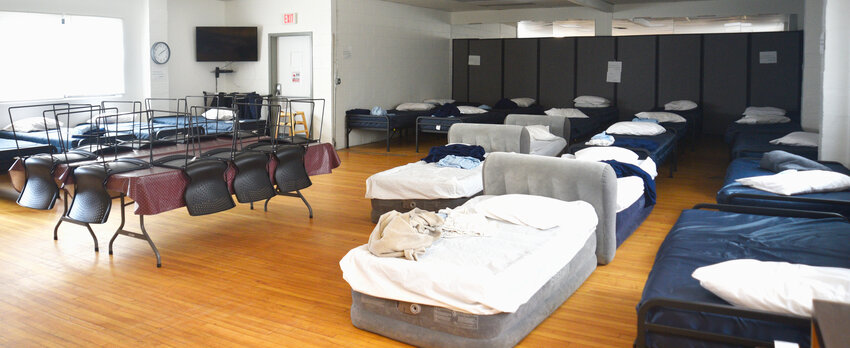
Sharing Squires stories
Students displaced by fire say thanks
Photos by Misha T. Kwasniewski/staff photographer
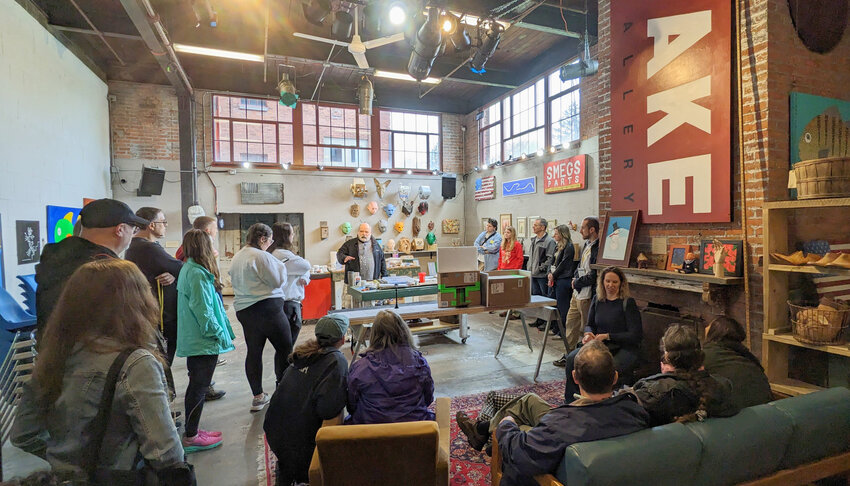
(ABOVE)Former Squires Building tenant Carly Semrau, right, with Mollie Lurken, expresses her gratitude to those who helped her and other tenants displaced when the building burned April 11, during a reception Thursday at SUNY Cortland.
(BELOW)John Gailor, fire investigator and president of the Cortland Fire Department Board of Engineers, looks over a collage of thank-you letters from Squires Building tenants.

To read this article and more, pick up today's Cortland Standard
Click here to subscribe
Shortfall seen for new voting machines
CORTLAND — Cortland County will receive $551,000 _to comply with the Help American Vote Act, but that won’t cover the total cost of updates the law requires.
The county could fall as much as $60,000 short of being HAVA compliant, said Democratic Election Commissioner Bill Wood.
“That is just not enough money for all the machines we’re going to need,” Wood said.
Wood and Republican Commissioner Bob Howe presented a possible solution to the Legislature’s Personnel Committee Thursday. The plan includes merging some of the county polling places to cut down on the number of new machines needed.
The current lever machines can handle up to 800 voters per day, according to Howe. That number will be dropped to about 450 with the new electronic machines.
“It’s a much more time-consuming process,” Wood said. “We are going to need more machines to cover all of our voters.”
Cortland County has 48 voting machines. The county would need up to 74 new electronic machines to cover voter population at current polling locations.
That number could be cut to 67 if the Legislature agrees to consolidate polling places among the county’s 19 legislative districts, Wood said.
To read this article and more, pick up today's Cortland Standard
Click here to subscribe
Dryden weighs Ellis Hollow water district
DRYDEN — The Town Board has agreed to host an informal meeting with residents in the Ellis Hollow area to determine who supports and doesn’t support bringing water to the area. The board then will determine what direction to go with a feasibility study.
The preliminary feasibility study showed that both a base area and an expanded area would be expensive at between $1,100 and $1,200 a year for a typical residence for usage and construction. Town Attorney Mahlon Perkins pointed out that this is about twice the state comptroller’s threshold of $579 for such projects in 2006. Thus the town would have to seek final state approval for the work from the comptroller if a majority of residents agreed to proceed with creating a water district.
Art Berkey, of 1205 Ellis Hollow Road, spoke in favor of completing the feasibility study at least for the original base area he had canvassed to seek support.
This area includes Ellis Hollow Road at Game Farm Road and extends to Turkey Hill Road, including Fox Hollow and Snyder Heights roads. It contains 111 parcels.
Berkey noted that his neighbor at 1105 Ellis Hollow Road, Cathi Calori, still runs out of water on the weekends. Dave Putnam, of T.G. Miller, the town’s engineering firm, said work would likely not start until 2007.
To read this article and more, pick up today's Cortland Standard
Click here to subscribe
4 in race for 3 Homer school seats
To read this article and more, pick up today's Cortland Standard
Click here to subscribe
Study: School tax proposals would rise above rate of inflation
From staff and wire reports
A recent analysis found school property taxes statewide would increase by just under twice the inflation rate, which is about 3 percent, but local school officials say the figures do not tell the whole story.
The analysis by The Public Policy Institute of New York State was done using data reported on the “Property Tax Report Card” school districts send to residents and the State Education Department. The report lists total spending, the school tax levy and enrollment figures for the current year, as well as the projections for 2006-07.
Comparing enrollment and spending figures from this report, school districts statewide plan to increase per-pupil spending by twice the rate of inflation and raise property taxes by more than $900 million or 6 percent on average, according to the annual “School Tax Watch” by the institute, part of the state Business Council.
Enrollment statewide is projected to increase 0.1 percent, said Robert Ward, the institute’s director. School spending per pupil statewide would increase an average of 6.2 percent to $16,469, he said.
The analysis comes after the state Legislature increased school operating aid by $1.1 billion, a record 6.9 percent. The Legislature also adopted a construction fund of $11.2 billion to be spent over several years.
Officials of some school districts in the Cortland County area said the figures released by The Public Policy Institute need to be put in perspective.
Bruce Sharpe, superintendent of schools in DeRuyter, said even though the district gets increases in state aid, the percent of the budget state aid pays for has decreased. He said from 1995 to 2002, the about 66 percent of the budget was funded with state aid, which has not kept pace with rising costs.
From 2002 to 2006 that percentage had dropped to 58. Sharpe said in the coming year he estimated the state aid would cover 58.5 percent of the budget. He said if the district had consistently received 66 percent in funding from the state, it would have amounted to more than an additional $1 million.
“We’re classified as a high risk rural school district,” said Sharpe. “We’re supposed to get more than the wealthier districts.” He said the low percentage puts the burden on the taxpayer.
———
Staff Reporter Ida M. Pease contributed to this article.
To read this article and more, pick up today's Cortland Standard
Click here to subscribe